 PsiQuant
Option A: Peakload Option (8am-8pm)
Peak Load Hedge
- Start Date: 01/01/2026 | Duration: 5 years
- Winter Strike: 116 €/MWh | Summer Strike: 65 €/MWh
- Observed Premium: 22 €/MWh
Discover our hourly price forward curve (HPFC) generator and its application in valuing complex energy derivatives.
This advanced simulator uses Monte Carlo methods to analyze production dispatch, price formation and hedging strategies on energy markets. The application can run thousands of stochastic scenarios and visualize the results interactively.
Architecture: The project is orchestrated around a Python pipeline that manages the stochastic diffusers, LP optimization and results compilation.
Use the interface below to configure the simulation, adjust the stochastic parameters and explore the results visually.
The accuracy of the HPFC generator is validated by its ability to assess the moneyness and premium of complex derivatives, based on specific consumption profiles.
Valuing these exotic options requires simulating thousands of hourly price paths (via the HPFC) to determine the probability and distribution of profits or losses (Moneyness). The Moneyness Histogram for Option A (Peakload) below shows the complexity of the risk profile and its marked deviation from normality:
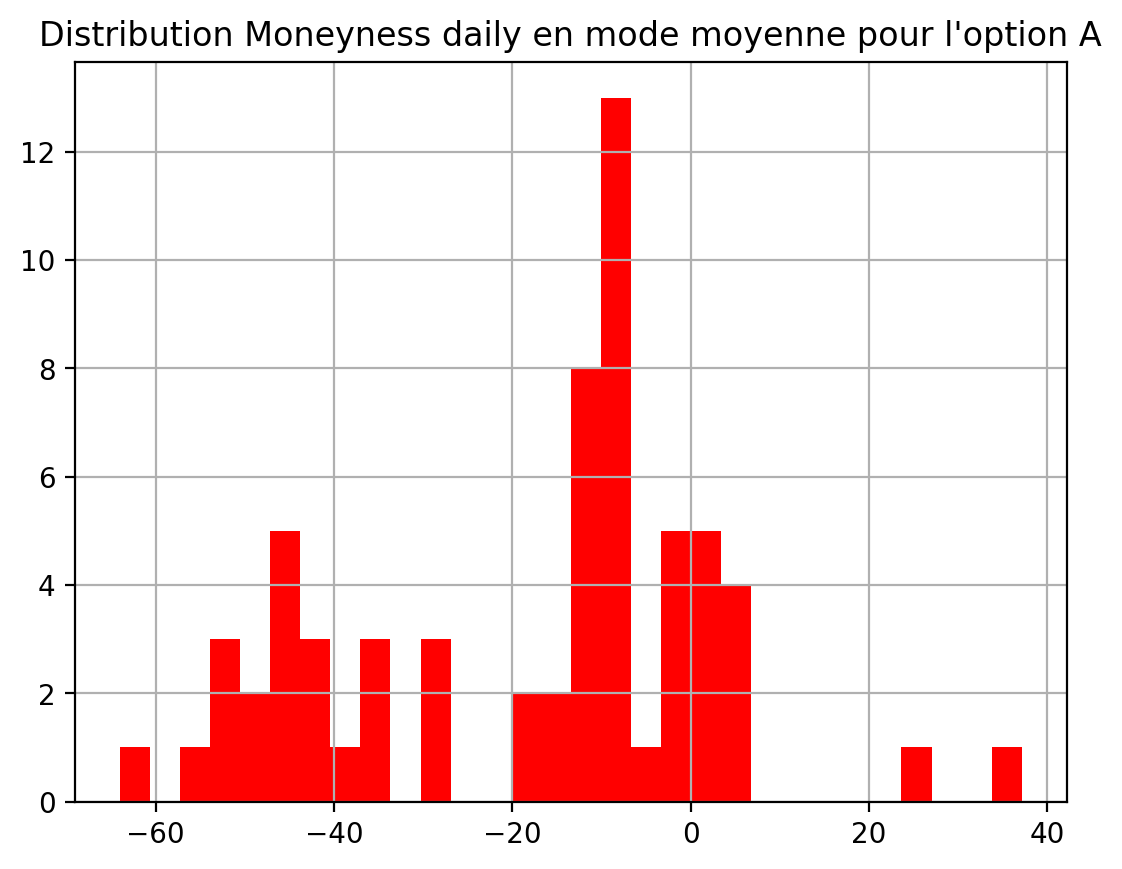
Analysis of this histogram reveals a strongly skewed distribution (negative skewness), characterized by a strong concentration of values around the central axis (slightly negative) but with a significant right tail (around €20 and above). This indicates that the most likely scenario is a moderate loss or small gain, but that the model simulates extreme price events (spikes) that translate into significant gains.
This risk asymmetry is typical of peak-load electricity markets, where capacity shortage risks are at their highest. The HPFC model is therefore essential to accurately value this risk asymmetry and determine a fair premium for Option A, justifying the premium difference observed with Option B (Night).
The full Delta, Gamma and Vega analysis of these options, as well as the theoretical premium calculation via Monte Carlo simulation, is available upon request.